User:PiusImpavidus/sandbox

The pros and cons of long trains
Several factors influence the choice for specific train lengths. In general, it can be said that longer trains pay off when distances are long. This explains the modest train lengths in places like Europe and Japan. Several considerations are mentioned here.
Advantages of long trains
Advantages of long trains show themselves best on long railways with homogeneous traffic.
- Goods trains need a single crew member (two in some jurisdictions) irrespective of train length. Longer trains reduce personnel costs per wagon. For passenger trains the effect is weaker as already with modest train lengths multiple ticket inspectors etc. are required.
- The headway required by a train does not depend on its length. With the distance between trains taken constant, track utilisation increases as train length increases. Therefore, using longer trains increases the capacity of a railway.
- If trains are longer, less trains are needed to transport the same amount of cargo. On single track lines this means passing loops can be made further apart. The passing loops have to be longer so it doesn't save on total track length, but the number of points and signals can be reduced and the passing loops may be moved to more convenient locations.
Disadvantages of long trains
Disadvantages of long trains show up when distances are short and average speeds are high.
- The strength of the couplings may be insufficient. European screw couplings can routinely handle 550 kN pulling force, which corresponds to a maximum train weight of about 3500 tonnes on a ruling gradient of 15‰. Other couplings, like the SA3 coupling or the Janney coupling can handle more force and therefore heaver and longer trains.
- Short trains can use more responsive braking systems, like the Hildebrand-Knorr brake, than longer trains, using Westinghouse brakes. Therefore they can keep a smaller margin between cruising speed and maximum speed on downhill stretches, increasing average speed.
- Longer trains have larger longitudinal forces causing larger lateral forces on the wagons in curves. This increases track and wheel maintenance, in particular on sinuous trajectories.
- Pulling heavy trains not only requires much traction, but doing so at any decent speed requires much power too. Pulling a 700 metre train on a slight incline may only require 500 kN of traction, but doing so at 100 km/h requires 14 MW of power. Overhead wires may not be capable of supplying this power. Diesel traction is no alternative at these speeds. Because of the low power to weight ratio of diesel locomotives, they would weigh as much as 25% of the train weight when running at this speed on this incline. The locomotive would waste 25% of its work moving itself instead of the goods. Still, to mix with passenger trains speeds of about 100 km/h may be required, preventing the use of very long trains.
- Long trains require long yards and passing tracks at stations. There may be no room to construct these.
- Any stockpiles of goods at source, destination or intermediate transshipment points represent idle capital, costing both money and storage space. Industries therefore prefer frequent small deliveries over occasional large ones, and small deleveries are made with shorter trains.
- Assembling a long train takes more time than assembling a short train. The wagons have to stay in the yard for as long as it takes to assemble a train, so when using long trains the wagons spend more time in the yard.
- When using long trains, goods for various destinations may have to be put together in a single train, requiring shunting along the way. When using multiple shorter trains, it's more likely that all goods on the train have the same destination, or at least, that this will be the case from a final shunting location farther away from the destination of the goods. This eliminates shunting, greatly reducing total travel time. This is not an argument in case of most bulk goods trains.
- On some railways old 8 bit axle counters are used, limiting trains to less than 256 axles. This can be solved easely.
- Counterintuitively, longer trains may reduce capacity. The capacity of a railway decreases as the spread in average speed increases. The fastest trains are passenger trains, which have preference when making timetables for publicly owned railways, and the speed of the fastest trains is therefore fixed. As longer trains are slower, the number of trains that can use the track every hour is reduced. The reduction in capacity is more or less proportional to the delay a goods train incurs on the passenger trains between two overtake sidings, relative to the time between two subsequent passenger trains.
For passenger trains there are some additional disadvantages to long trains.
- Long trains require passengers to walk long distances to get to their seats or to the station's exit. Passengers don't want to walk more than a few hundred metres.
- With longer trains and longer distances to walk, passengers need more time to change trains. This increases total travel time, causing passengers to seek an alternative mode of transport.
- With a frequent service, passengers get more opportunities to travel and on average have to wait shorter when changing trains. This increases the number of passengers and revenue. Authorities may require a high frequency for handing a train operator a consession or subsidy. Higher frequencies reduce the number of passengers per train, allowing for shorter trains.
Cant
The ideal amount of superelevation , given the speed of a train, the radius of curvature and the gauge of the track, the relation


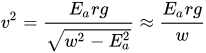
has to be fulfilled, with the gravitational acceleration. This follows simply from a balance between weight, centrifugal force and normal force. In the approximation it is assumed that the superelevation is small compared to the gauge of the track. It is often convenient to define the unbalanced superelevation as the maximum allowed additional amount of superelevation that would be required by a train moving faster than the speed for which the superelevation was designed, setting the maximum allowed speed . In a formula this becomes



with the curvature of the track, which is also the turn in radians per unit length of track.

In the United States, maximum speed is subject to specific rules. When filling in , and the conversion factors for US customary units, the maximum speed of a train on curved track for a given cant deficiency or unbalanced superelevation is determined by the following formula:


with and in inches, the degree of curvature in degrees per 100 feet and in mph.

For the United States standard maximum unbalanced superelevation of 75 mm (3 in), the formula is:
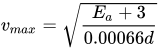
Content Disclaimer
Informasi ini disarikan dari Wikipedia dan disajikan kembali untuk tujuan edukasi. Konten tersedia di bawah lisensi CC BY-SA 3.0. Kami tidak bertanggung jawab atas ketidakakuratan data yang bersumber dari kontribusi publik tersebut.
- The information displayed on this website is sourced in part or in whole from Wikipedia and has been adapted for the purpose of restating it. We strive to provide accurate and relevant information, however:
- There is no guarantee of absolute accuracy. Wikipedia is an open, collaborative project that can be edited by anyone, so information is subject to change.
- It is not intended to constitute professional advice. The content displayed is for informational and educational purposes only. For important decisions (e.g., medical, legal, or financial), please consult a professional.
- Content copyright. Wikipedia is licensed under the Creative Commons Attribution-ShareAlike License (CC BY-SA). This means that content may be reused with appropriate attribution and shared under a similar license.
- Responsible use. Any risk arising from the use of information from this website is entirely the responsibility of the user.