User:Longape/sandbox

In Stokes flow, Stokes' paradox refers to the fact that there can be no creeping flow of a fluid around a disk in two dimensions; or, equivalently, the fact there is no non-trivial, steady state solution for the Stokes equations around an infinitely long cylinder. This is opposed to the 3-dimensional case, where Stokes' method provides a solution to the problem of flow around a sphere.[1]
Derivation
The velocity vector of the fluid may be written in terms of the stream function as:


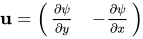
As the stream function in a Stokes flow problem, satisfies the biharmonic equation.[2] Since the plane may be regarded to as the complex plane, the problem may be dealt with using methods of complex analysis. In this approach, is either the real or imaginary part of:

Here , where is the imaginary unit, and are holomorphic functions outside of the disk. We will take the real part without loss of generality. Now the function , defined by is introduced. can be written as , or (using the Wirtinger derivatives). This is calculated to be equal to:


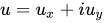



Without loss of generality, the disk may be assumed to be the unit disk, consisting of all complex numbers z of absolute value smaller or equal to 1.
The boundary conditions are and whenever ,[4][5] and by representing the functions as Laurent series:[6]



the first condition implies for all .


Using the polar form of results in . After deriving the series form of u and substituting this into it along with , and changing some indices, the second boundary condition translates to:



.

Since the complex trigonometric functions compose a linearly independent set, it follows that all coefficients in the series are zero. Examining these conditions for every after taking into account the the condition at infinity shows that and are necessarily of the form:



where is an imaginary number (opposite to its own complex conjugate) and and are complex numbers. Substituting this into gives the result that globally, compelling both and to be zero. Therefore there can be no motion - the only solution is that the cylinder is at rest relative to all points of the fluid.


Resolution
The paradox is caused by the limited validity of Stokes' approximation, as explained in Oseen's criticism: the validity of Stokes' equations relies on Reynolds number being small, and this condition cannot hold for arbitrarily large distances .[7]

A correct solution for a cylinder was derived using Oseen's equations, and the same equations lead to an improved approximation of the drag force on a sphere.[8]
See Also
References
- ^ Lamb, Horace (1945). Hydrodynamics (Sixth ed.). New York: Dover Publications. pp. 602–604.
- ^ Lamb, Horace (1945). Hydrodynamics (Sixth ed.). New York: Dover Publications. p. 602.
- ^ Weisstein, Eric W. (2002). CRC Concise Encyclopedia of Mathematics. CRC Press. ISBN 1584883472.
- ^ Lamb, Horace (1945). Hydrodynamics (Sixth ed.). New York: Dover Publications. pp. 602–604.
- ^ Lamb, Horace (1945). Hydrodynamics (Sixth ed.). New York: Dover Publications. p. 615.
- ^ Sarason, Donald (1994). Notes on Complex Function Theory. Berkeley, California.
{{cite book}}: CS1 maint: location missing publisher (link) - ^ Lamb, Horace (1945). Hydrodynamics (Sixth ed.). New York: Dover Publications. pp. 608–609.
- ^ Lamb, Horace (1945). Hydrodynamics (Sixth ed.). New York: Dover Publications. pp. 609–616.
Content Disclaimer
Informasi ini disarikan dari Wikipedia dan disajikan kembali untuk tujuan edukasi. Konten tersedia di bawah lisensi CC BY-SA 3.0. Kami tidak bertanggung jawab atas ketidakakuratan data yang bersumber dari kontribusi publik tersebut.
- The information displayed on this website is sourced in part or in whole from Wikipedia and has been adapted for the purpose of restating it. We strive to provide accurate and relevant information, however:
- There is no guarantee of absolute accuracy. Wikipedia is an open, collaborative project that can be edited by anyone, so information is subject to change.
- It is not intended to constitute professional advice. The content displayed is for informational and educational purposes only. For important decisions (e.g., medical, legal, or financial), please consult a professional.
- Content copyright. Wikipedia is licensed under the Creative Commons Attribution-ShareAlike License (CC BY-SA). This means that content may be reused with appropriate attribution and shared under a similar license.
- Responsible use. Any risk arising from the use of information from this website is entirely the responsibility of the user.