Tate's algorithm
In the theory of elliptic curves, Tate's algorithm takes as input an integral model of an elliptic curve E over , or more generally an algebraic number field, and a prime or prime ideal p. It returns the exponent fp of p in the conductor of E, the type of reduction at p, the local index

![{\displaystyle c_{p}=[E(\mathbb {Q} _{p}):E^{0}(\mathbb {Q} _{p})],}](https://wikimedia.org/api/rest_v1/media/math/render/svg/ebb20876b4c05bd1392e5076b57e88e15b829929)
where is the group of -points whose reduction mod p is a non-singular point. Also, the algorithm determines whether or not the given integral model is minimal at p, and, if not, returns an integral model with integral coefficients for which the valuation at p of the discriminant is minimal.


Tate's algorithm also gives the structure of the singular fibers given by the Kodaira symbol or Néron symbol, for which, see elliptic surfaces: in turn this determines the exponent fp of the conductor E.
Tate's algorithm can be greatly simplified if the characteristic of the residue class field is not 2 or 3; in this case the type and c and f can be read off from the valuations of j and Δ (defined below).
Tate's algorithm was introduced by John Tate (1975) as an improvement of the description of the Néron model of an elliptic curve by Néron (1964).
Notation
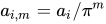
Assume that all the coefficients of the equation of the curve lie in a complete discrete valuation ring R with perfect residue field K and maximal ideal generated by a prime π. The elliptic curve is given by the equation

Define:
- the p-adic valuation of in , that is, exponent of in prime factorization of , or infinity if







The algorithm
- Step 1: If π does not divide Δ then the type is I0, c=1 and f=0.
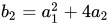
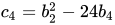
- Step 2: If π divides Δ but not c4 then the type is Iv with v = v(Δ), c=v, and f=1.
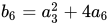
- Step 3. Otherwise, change coordinates so that π divides a3,a4,a6. If π2 does not divide a6 then the type is II, c=1, and f=v(Δ);
- Step 4. Otherwise, if π3 does not divide b8 then the type is III, c=2, and f=v(Δ)−1;
- Step 5. Otherwise, let Q1 be the polynomial
- .
- If π3 does not divide b6 then the type is IV, c=3 if has two roots in K and 1 if it has two roots outside of K, and f=v(Δ)−2.


- Step 6. Otherwise, change coordinates so that π divides a1 and a2, π2 divides a3 and a4, and π3 divides a6. Let P be the polynomial
- If has 3 distinct roots modulo π then the type is I0*, f=v(Δ)−4, and c is 1+(number of roots of P in K).


- Step 7. If P has one single and one double root, then the type is Iν* for some ν>0, f=v(Δ)−4−ν, c=2 or 4: there is a "sub-algorithm" for dealing with this case.
- Step 8. If P has a triple root, change variables so the triple root is 0, so that π2 divides a2 and π3 divides a4, and π4 divides a6. Let Q2 be the polynomial
- .
- If has two distinct roots modulo π then the type is IV*, f=v(Δ)−6, and c is 3 if the roots are in K, 1 otherwise.


- Step 9. If has a double root, change variables so the double root is 0. Then π3 divides a3 and π5 divides a6. If π4 does not divide a4 then the type is III* and f=v(Δ)−7 and c = 2.
- Step 10. Otherwise if π6 does not divide a6 then the type is II* and f=v(Δ)−8 and c = 1.
- Step 11. Otherwise the equation is not minimal. Divide each an by πn and go back to step 1.
Implementations
The algorithm is implemented for algebraic number fields in the PARI/GP computer algebra system, available through the function elllocalred.
References
- Cremona, John (1997), Algorithms for modular elliptic curves (2nd ed.), Cambridge: Cambridge University Press, ISBN 0-521-59820-6, Zbl 0872.14041, retrieved 2007-12-20
- Laska, Michael (1982), "An Algorithm for Finding a Minimal Weierstrass Equation for an Elliptic Curve", Mathematics of Computation, 38 (157): 257–260, doi:10.2307/2007483, JSTOR 2007483, Zbl 0493.14016
- Néron, André (1964), "Modèles minimaux des variétés abèliennes sur les corps locaux et globaux", Publications Mathématiques de l'IHÉS (in French), 21: 5–128, doi:10.1007/BF02684271, MR 0179172, Zbl 0132.41403
- Silverman, Joseph H. (1994), Advanced Topics in the Arithmetic of Elliptic Curves, Graduate Texts in Mathematics, vol. 151, Springer-Verlag, ISBN 0-387-94328-5, Zbl 0911.14015
- Tate, John (1975), "Algorithm for determining the type of a singular fiber in an elliptic pencil", in Birch, B.J.; Kuyk, W. (eds.), Modular Functions of One Variable IV, Lecture Notes in Mathematics, vol. 476, Berlin / Heidelberg: Springer, pp. 33–52, doi:10.1007/BFb0097582, ISBN 978-3-540-07392-5, ISSN 1617-9692, MR 0393039, Zbl 1214.14020
Content Disclaimer
Informasi ini disarikan dari Wikipedia dan disajikan kembali untuk tujuan edukasi. Konten tersedia di bawah lisensi CC BY-SA 3.0. Kami tidak bertanggung jawab atas ketidakakuratan data yang bersumber dari kontribusi publik tersebut.
- The information displayed on this website is sourced in part or in whole from Wikipedia and has been adapted for the purpose of restating it. We strive to provide accurate and relevant information, however:
- There is no guarantee of absolute accuracy. Wikipedia is an open, collaborative project that can be edited by anyone, so information is subject to change.
- It is not intended to constitute professional advice. The content displayed is for informational and educational purposes only. For important decisions (e.g., medical, legal, or financial), please consult a professional.
- Content copyright. Wikipedia is licensed under the Creative Commons Attribution-ShareAlike License (CC BY-SA). This means that content may be reused with appropriate attribution and shared under a similar license.
- Responsible use. Any risk arising from the use of information from this website is entirely the responsibility of the user.