Talk:Volterra's function
 | This article is rated Start-class on Wikipedia's content assessment scale. It is of interest to the following WikiProjects: | |||||||||||||||||||||||
| ||||||||||||||||||||||||


Broken external link
I tried the external link http://www.macalester.edu/~bressoud/talks/Volterra-4.pdf today, but it was broken. 152.3.25.70 (talk) 18:15, 13 April 2009 (UTC)
second to last paragraph is wrong
The second to last paragraph:
- Volterra's function is differentiable everywhere just as f(x) (defined above) is. The derivative V ′(x) is discontinuous at the endpoints of every interval removed in the construction of the SVC, but the function is differentiable at these points with value 0. Furthermore, in any neighbourhood of such a point there are points where V ′(x) takes values 1 and −1. It follows that it is not possible, for every ε > 0, to find a partition of the real line such that |V ′(x2) − V ′(x1)| < ε on every interval [x1, x2] of the partition. Therefore, the derivative V ′(x) is not Riemann integrable.
is wrong. For one thing, the derivative V'(x) is discontinuous not just at the endpoints of every interval removed in the SVC construction, but actually on the entire Smith-Volterra-Cantor set. This is extremely important. It follows from Lebesgue's criterion for Riemann integrability that the derivative V' is not Riemann integrable. Furthermore, in the conclusion,
- It follows that it is not possible, for every ε > 0, to find a partition of the real line such that |V ′(x2) − V ′(x1)| < ε on every interval [x1, x2] of the partition. Therefore, the derivative V ′(x) is not Riemann integrable.
is completely false. The first sentence is wrong, since one can choose a partition so that V'(x)=0 for every x which is the endpoint of an interval in the partition (the partition {0,1} comes to mind). I'm not quite sure what the author meant - the closest thing I can guess is something like the definition of uniform continuity? In any case, the second sentence doesn't follow from the first (or even a modified version of it), since continuity is not required for Riemann integrability. For instance, if you take the function
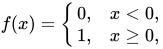
then in any partition of [-1,1], there will always be a subinterval in which the function takes both zero and one as values. However, the function is Riemann integrable, since the difference between the upper and lower Riemann sums is simply the width of that subinterval, which can be made arbitrarily small.
In fact, nowhere in the given explanation does it refer to or make use of that fact that the SVC has positive measure (which is the entire point behind the construction of the SVC). If one repeated the construction of Volterra's function with the ordinary measure 0 Cantor set instead of the SVC, one would get a function whose derivative IS Riemann integrable (again, by Lebesgue's criterion for Riemann integrability). The article should point this out.
I intend to correct the mistake at some point, but maybe someone else will get to it first. In any case, when I do, I figured this more detailed explanation will serve as a useful addition to the (necessarily short) edit summary.
--skeptical scientist (talk) 23:57, 25 January 2011 (UTC)
- I fixed the errors, although the resulting section is still fairly short and may be hard to follow for some. It's basically a list of properties of V which together form a sort of a proof sketch that V has a non-integrable derivative. This is probably great from the standpoint of a bright reader who knows a fair amount of real analysis and measure theory. However, it is probably hard to follow for someone who is just learning about things like Riemann integrability and Lebesgue measure, so could do with more fleshing out. However, it at least now has the virtue of being true, so I'll leave any fleshing out to be done to some other contributor. skeptical scientist (talk) 03:01, 26 January 2011 (UTC)
pictures wanted
In musing what would really help this article be more understandable, I think pictures are the key. If someone with some good graphing software could generate images of f, f1, f2, and V, I think that would really go a long way towards helping people understand the construction (which, as is, is probably fairly hard to follow for someone who doesn't already have some idea what is going on). I'd do it myself, but I don't really know a good program to use. skeptical scientist (talk) 03:39, 26 January 2011 (UTC)
Content Disclaimer
Informasi ini disarikan dari Wikipedia dan disajikan kembali untuk tujuan edukasi. Konten tersedia di bawah lisensi CC BY-SA 3.0. Kami tidak bertanggung jawab atas ketidakakuratan data yang bersumber dari kontribusi publik tersebut.
- The information displayed on this website is sourced in part or in whole from Wikipedia and has been adapted for the purpose of restating it. We strive to provide accurate and relevant information, however:
- There is no guarantee of absolute accuracy. Wikipedia is an open, collaborative project that can be edited by anyone, so information is subject to change.
- It is not intended to constitute professional advice. The content displayed is for informational and educational purposes only. For important decisions (e.g., medical, legal, or financial), please consult a professional.
- Content copyright. Wikipedia is licensed under the Creative Commons Attribution-ShareAlike License (CC BY-SA). This means that content may be reused with appropriate attribution and shared under a similar license.
- Responsible use. Any risk arising from the use of information from this website is entirely the responsibility of the user.