Talk:Transversality
 | This article was nominated for deletion on 24 July 2025. The result of the discussion was Transversality (mathematics) moved to Transversality. |
 | This article is rated Start-class on Wikipedia's content assessment scale. It is of interest to the following WikiProjects: | ||||||||||
| |||||||||||


Untitled
If someone's more capable than I, a picture of transverse and tangent plane curves would be an excellent addition to this article! David Farris 21:30, 4 December 2005 (UTC)
"Generate"??
To answer this implied question: Two vector subspaces V and W of a vector space X are said to "generate" X if every vector x ∈ X can be expressed as the sum
x = v + w
of some vectors v ∈ V and w ∈ W. This is possible — but not necessarily the case — only when dim(V) + dim(W) ≥ dim(X).
If dim(V) + dim(W) = dim(X), then given x ∈ X, the representation x = v + w will be unique. Otherwise, there will be many ways to express x as v + w for some v ∈ V and w ∈ W.
For instance, the xy-plane V and the yz-plane W are 2-dimensional subspaces of the 3-dimensional real vector space R3 that generate R3.
Optimal control example is poorly described
The Optimal control section begins as follows:
"In fields utilizing the calculus of variations or the related Pontryagin maximum principle, the transversality condition is frequently used to control the types of solutions found in optimization problems. For example, it is a necessary condition for solution curves to problems of the form:
- Minimize where one or both of the endpoints of the curve are not fixed."
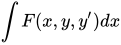
But "the curve" referred to here is never mentioned, not in the above passage and not later in this section.
Also (and no doubt related to this) is that in the integration above, the region of integration is unfortunately never mentioned.
I hope that someone familiar with this subject, and with how to write clearly, can fix this.
Content Disclaimer
Informasi ini disarikan dari Wikipedia dan disajikan kembali untuk tujuan edukasi. Konten tersedia di bawah lisensi CC BY-SA 3.0. Kami tidak bertanggung jawab atas ketidakakuratan data yang bersumber dari kontribusi publik tersebut.
- The information displayed on this website is sourced in part or in whole from Wikipedia and has been adapted for the purpose of restating it. We strive to provide accurate and relevant information, however:
- There is no guarantee of absolute accuracy. Wikipedia is an open, collaborative project that can be edited by anyone, so information is subject to change.
- It is not intended to constitute professional advice. The content displayed is for informational and educational purposes only. For important decisions (e.g., medical, legal, or financial), please consult a professional.
- Content copyright. Wikipedia is licensed under the Creative Commons Attribution-ShareAlike License (CC BY-SA). This means that content may be reused with appropriate attribution and shared under a similar license.
- Responsible use. Any risk arising from the use of information from this website is entirely the responsibility of the user.