Sticking probability
The sticking probability is the probability that molecules are trapped on surfaces and adsorb chemically. From Langmuir's adsorption isotherm, molecules cannot adsorb on surfaces when the adsorption sites are already occupied by other molecules, so the sticking probability can be expressed as follows:
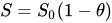
where is the initial sticking probability and is the surface coverage fraction ranging from 0 to 1.


Similarly, when molecules adsorb on surfaces dissociatively, the sticking probability is
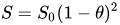
The square is because a disassociation of 1 molecule into 2 parts requires 2 adsorption sites. These equations are simple and can be easily understood but cannot explain experimental results.
In 1958, P. Kisliuk[1] presented an equation for the sticking probability that can explain experimental results. In his theory, molecules are trapped in precursor states of physisorption before chemisorption. Then the molecules meet adsorption sites that molecules can adsorb to chemically, so the molecules behave as follows.
If these sites are not occupied, molecules do the following (with probability in parentheses):
- adsorb on the surface chemically ()
- desorb from the surface ()
- move to the next precursor state ()


and if these sites are occupied, they
- desorb from the surface ()
- move to the next precursor state ()


Note that an occupied site is defined as one where there is a chemically bonded adsorbate so by definition it would be . Then the sticking probability is, according to equation (6) of the reference,[1]


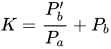
When , this equation is identical in result to Langmuir's adsorption isotherm.

Notes
- ^ a b Kisliuk, Paul (1957). "The sticking probabilities of gases chemisorbed on the surfaces of solids". Journal of Physics and Chemistry of Solids. 3 (1–2): 95–101. Bibcode:1957JPCS....3...95K. doi:10.1016/0022-3697(57)90054-9.
References
- The constitution and fundamental properties of solids and liquids. part i. solids. Irving Langmuir; J. Am. Chem. Soc. 38, 2221-95 1916 Langmuir, I. (1916). "The Constitution and Fundamental Properties of Solids and Liquids. Part I. Solids". Journal of the American Chemical Society. 38 (11): 2221–2295. doi:10.1021/ja02268a002.
Content Disclaimer
Informasi ini disarikan dari Wikipedia dan disajikan kembali untuk tujuan edukasi. Konten tersedia di bawah lisensi CC BY-SA 3.0. Kami tidak bertanggung jawab atas ketidakakuratan data yang bersumber dari kontribusi publik tersebut.
- The information displayed on this website is sourced in part or in whole from Wikipedia and has been adapted for the purpose of restating it. We strive to provide accurate and relevant information, however:
- There is no guarantee of absolute accuracy. Wikipedia is an open, collaborative project that can be edited by anyone, so information is subject to change.
- It is not intended to constitute professional advice. The content displayed is for informational and educational purposes only. For important decisions (e.g., medical, legal, or financial), please consult a professional.
- Content copyright. Wikipedia is licensed under the Creative Commons Attribution-ShareAlike License (CC BY-SA). This means that content may be reused with appropriate attribution and shared under a similar license.
- Responsible use. Any risk arising from the use of information from this website is entirely the responsibility of the user.