Stein factorization
In algebraic geometry, the Stein factorization, introduced by Karl Stein (1956) for the case of complex spaces, states that a proper morphism of schemes can be factorized as a composition of a finite mapping and a proper morphism with connected fibers. Roughly speaking, Stein factorization contracts the connected components of the fibers of a mapping to points.
Statement
One version for schemes states the following: (EGA, III.4.3.1)
Let X be a scheme, S a locally noetherian scheme and a proper morphism. Then one can write
where is a finite morphism and is a proper morphism so that


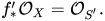
The existence of this decomposition itself is not difficult. See below. But, by Zariski's connectedness theorem, the last part in the above says that the fiber is connected for any . It follows:


Corollary: For any , the set of connected components of the fiber is in bijection with the set of points in the fiber .


Proof
Set:

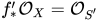
where SpecS is the relative Spec. The construction gives the natural map , which is finite since is coherent and f is proper. The morphism f factors through g and one gets , which is proper. By construction, . One then uses the theorem on formal functions to show that the last equality implies has connected fibers. (This part is sometimes referred to as Zariski's connectedness theorem.)


See also
References
- Hartshorne, Robin (1977), Algebraic Geometry, Graduate Texts in Mathematics, vol. 52, New York: Springer-Verlag, ISBN 978-0-387-90244-9, MR 0463157
- Grothendieck, Alexandre; Dieudonné, Jean (1961). "Eléments de géométrie algébrique: III. Étude cohomologique des faisceaux cohérents, Première partie". Publications Mathématiques de l'IHÉS. 11. doi:10.1007/bf02684274. MR 0217085.
- Stein, Karl (1956), "Analytische Zerlegungen komplexer Räume", Mathematische Annalen, 132: 63–93, doi:10.1007/BF01343331, ISSN 0025-5831, MR 0083045
Content Disclaimer
Informasi ini disarikan dari Wikipedia dan disajikan kembali untuk tujuan edukasi. Konten tersedia di bawah lisensi CC BY-SA 3.0. Kami tidak bertanggung jawab atas ketidakakuratan data yang bersumber dari kontribusi publik tersebut.
- The information displayed on this website is sourced in part or in whole from Wikipedia and has been adapted for the purpose of restating it. We strive to provide accurate and relevant information, however:
- There is no guarantee of absolute accuracy. Wikipedia is an open, collaborative project that can be edited by anyone, so information is subject to change.
- It is not intended to constitute professional advice. The content displayed is for informational and educational purposes only. For important decisions (e.g., medical, legal, or financial), please consult a professional.
- Content copyright. Wikipedia is licensed under the Creative Commons Attribution-ShareAlike License (CC BY-SA). This means that content may be reused with appropriate attribution and shared under a similar license.
- Responsible use. Any risk arising from the use of information from this website is entirely the responsibility of the user.