Selberg zeta function
 | This article includes a list of references, related reading, or external links, but its sources remain unclear because it lacks inline citations. (April 2022) |
The Selberg zeta-function was introduced by Atle Selberg (1956). It is analogous to the famous Riemann zeta function
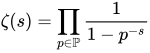
where is the set of prime numbers. The Selberg zeta-function uses the lengths of simple closed geodesics instead of the prime numbers. If is a subgroup of SL(2, R), the associated Selberg zeta function is defined as follows,


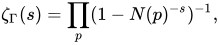
or
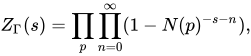
where p runs over conjugacy classes of prime geodesics (equivalently, conjugacy classes of primitive hyperbolic elements of ), and N(p) denotes (equivalently, the square of the bigger eigenvalue of p).

For any hyperbolic surface of finite area there is an associated Selberg zeta-function; this function is a meromorphic function defined in the complex plane. The zeta function is defined in terms of the closed geodesics of the surface.
The zeros and poles of the Selberg zeta-function, Z(s), can be described in terms of spectral data of the surface.
The zeros are at the following points:
- For every cusp form with eigenvalue there exists a zero at the point . The order of the zero equals the dimension of the corresponding eigenspace. (A cusp form is an eigenfunction to the Laplace–Beltrami operator which has Fourier expansion with zero constant term.)
- The zeta-function also has a zero at every pole of the determinant of the scattering matrix, . The order of the zero equals the order of the corresponding pole of the scattering matrix.


The zeta-function also has poles at , and can have zeros or poles at the points .


The Ihara zeta function is considered a p-adic (and a graph-theoretic) analogue of the Selberg zeta function.
Selberg zeta-function for the modular group
For the case where the surface is , where is the modular group, the Selberg zeta-function is of special interest. For this special case the Selberg zeta-function is intimately connected to the Riemann zeta-function.

In this case the determinant of the scattering matrix is given by:

In particular, we see that if the Riemann zeta-function has a zero at , then the determinant of the scattering matrix has a pole at , and hence the Selberg zeta-function has a zero at .[citation needed]

See also
References
- Fischer, Jürgen (1987), An Approach to the Selberg Trace Formula via the Selberg Zeta-Function, Lecture Notes in Mathematics, vol. 1253, Berlin, New York: Springer-Verlag, doi:10.1007/BFb0077696, ISBN 978-3-540-15208-8, MR 0892317
- Hejhal, Dennis A. (1976), The Selberg trace formula for PSL(2,R). Vol. I, Lecture Notes in Mathematics, Vol. 548, vol. 548, Berlin, New York: Springer-Verlag, doi:10.1007/BFb0079608, ISBN 978-3-540-07988-0, MR 0439755
- Hejhal, Dennis A. (1983), The Selberg Trace Formula for PSL(2,ℝ), Lecture Notes in Mathematics, vol. 1001, Berlin, New York: Springer-Verlag, doi:10.1007/BFb0061302, ISBN 978-3-540-12323-1, MR 0711197
- Iwaniec, H. Spectral methods of automorphic forms, American Mathematical Society, second edition, 2002.
- Selberg, Atle (1956), "Harmonic analysis and discontinuous groups in weakly symmetric Riemannian spaces with applications to Dirichlet series", J. Indian Math. Soc., New Series, 20: 47–87, MR 0088511
- Venkov, A. B. Spectral theory of automorphic functions. Proc. Steklov. Inst. Math, 1982.
- Sunada, T., L-functions in geometry and some applications, Proc. Taniguchi Symp. 1985, "Curvature and Topology of Riemannian Manifolds", Springer Lect. Note in Math. 1201(1986), 266-284.
Content Disclaimer
Informasi ini disarikan dari Wikipedia dan disajikan kembali untuk tujuan edukasi. Konten tersedia di bawah lisensi CC BY-SA 3.0. Kami tidak bertanggung jawab atas ketidakakuratan data yang bersumber dari kontribusi publik tersebut.
- The information displayed on this website is sourced in part or in whole from Wikipedia and has been adapted for the purpose of restating it. We strive to provide accurate and relevant information, however:
- There is no guarantee of absolute accuracy. Wikipedia is an open, collaborative project that can be edited by anyone, so information is subject to change.
- It is not intended to constitute professional advice. The content displayed is for informational and educational purposes only. For important decisions (e.g., medical, legal, or financial), please consult a professional.
- Content copyright. Wikipedia is licensed under the Creative Commons Attribution-ShareAlike License (CC BY-SA). This means that content may be reused with appropriate attribution and shared under a similar license.
- Responsible use. Any risk arising from the use of information from this website is entirely the responsibility of the user.