PDE surface
PDE surfaces are used in geometric modelling and computer graphics for creating smooth surfaces conforming to a given boundary configuration. PDE surfaces use partial differential equations to generate a surface which usually satisfy a mathematical boundary value problem.
PDE surfaces were first introduced into the area of geometric modelling and computer graphics by two British mathematicians, Malcolm Bloor and Michael Wilson.
Technical details
The PDE method involves generating a surface for some boundary by means of solving an elliptic partial differential equation of the form
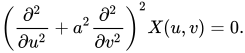
Here is a function parameterised by the two parameters and such that where , and are the usual cartesian coordinate space. The boundary conditions on the function and its normal derivatives are imposed at the edges of the surface patch.





With the above formulation it is notable that the elliptic partial differential operator in the above PDE represents a smoothing process in which the value of the function at any point on the surface is, in some sense, a weighted average of the surrounding values. In this way, a surface is obtained as a smooth transition between the chosen set of boundary conditions. The parameter is a special design parameter which controls the relative smoothing of the surface in the and directions.

When , the PDE is the biharmonic equation: . The biharmonic equation is the equation produced by applying the Euler-Lagrange equation to the simplified thin plate energy functional . So solving the PDE with is equivalent to minimizing the thin plate energy functional subject to the same boundary conditions.



Applications
PDE surfaces can be used in many application areas. These include computer-aided design, interactive design, parametric design, computer animation, computer-aided physical analysis and design optimisation.
Related publications
- M.I.G. Bloor and M.J. Wilson, Generating Blend Surfaces using Partial Differential Equations, Computer Aided Design, 21(3), 165–171, (1989).
- H. Ugail, M.I.G. Bloor, and M.J. Wilson, Techniques for Interactive Design Using the PDE Method, ACM Transactions on Graphics, 18(2), 195–212, (1999).
- J. Huband, W. Li and R. Smith, An Explicit Representation of Bloor-Wilson PDE Surface Model by using Canonical Basis for Hermite Interpolation, Mathematical Engineering in Industry, 7(4), 421-33 (1999).
- H. Du and H. Qin, Direct Manipulation and Interactive Sculpting of PDE surfaces, Computer Graphics Forum, 19(3), C261-C270, (2000).
- H. Ugail, Spine Based Shape Parameterisations for PDE surfaces, Computing, 72, 195–204, (2004).
- L. You, P. Comninos, J.J. Zhang, PDE Blending Surfaces with C2 Continuity, Computers and Graphics, 28(6), 895–906, (2004).
External links
- Simulation based design, DVE research (University of Bradford, UK) Archived 2006-02-04 at the Wayback Machine. (A java applet demonstrating the properties of PDE surfaces)
- Dept Applied Mathematics, University of Leeds details on Bloor and Wilsons work.
Content Disclaimer
Informasi ini disarikan dari Wikipedia dan disajikan kembali untuk tujuan edukasi. Konten tersedia di bawah lisensi CC BY-SA 3.0. Kami tidak bertanggung jawab atas ketidakakuratan data yang bersumber dari kontribusi publik tersebut.
- The information displayed on this website is sourced in part or in whole from Wikipedia and has been adapted for the purpose of restating it. We strive to provide accurate and relevant information, however:
- There is no guarantee of absolute accuracy. Wikipedia is an open, collaborative project that can be edited by anyone, so information is subject to change.
- It is not intended to constitute professional advice. The content displayed is for informational and educational purposes only. For important decisions (e.g., medical, legal, or financial), please consult a professional.
- Content copyright. Wikipedia is licensed under the Creative Commons Attribution-ShareAlike License (CC BY-SA). This means that content may be reused with appropriate attribution and shared under a similar license.
- Responsible use. Any risk arising from the use of information from this website is entirely the responsibility of the user.