Monogenic system
In classical mechanics, a physical system is termed a monogenic system if the force acting on the system can be modelled in a particular, especially convenient mathematical form. The systems that are typically studied in physics are monogenic. The term was introduced by Cornelius Lanczos in his book The Variational Principles of Mechanics (1970).[1][2]
In Lagrangian mechanics, the property of being monogenic is a necessary condition for certain different formulations to be mathematically equivalent. If a physical system is both a holonomic system and a monogenic system, then it is possible to derive Lagrange's equations from d'Alembert's principle; it is also possible to derive Lagrange's equations from Hamilton's principle.[3]
Mathematical definition
In a physical system, if all forces, with the exception of the constraint forces, are derivable from the generalized scalar potential, and this generalized scalar potential is a function of generalized coordinates, generalized velocities, or time, then, this system is a monogenic system.
Expressed using equations, the exact relationship between generalized force and generalized potential is as follows:


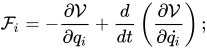
where is generalized coordinate, is generalized velocity, and is time.


If the generalized potential in a monogenic system depends only on generalized coordinates, and not on generalized velocities and time, then, this system is a conservative system. The relationship between generalized force and generalized potential is as follows:

See also
References
- ^ J., Butterfield (3 September 2004). "Between Laws and Models: Some Philosophical Morals of Lagrangian Mechanics" (PDF). PhilSci-Archive. p. 43. Archived from the original (PDF) on 3 November 2018. Retrieved 23 January 2015.
- ^ Cornelius, Lanczos (1970). The Variational Principles of Mechanics. Toronto: University of Toronto Press. p. 30. ISBN 0-8020-1743-6.
- ^ Goldstein, Herbert; Poole, Charles P. Jr.; Safko, John L. (2002). Classical Mechanics (3rd ed.). San Francisco, CA: Addison Wesley. pp. 18–21, 45. ISBN 0-201-65702-3.
Content Disclaimer
Informasi ini disarikan dari Wikipedia dan disajikan kembali untuk tujuan edukasi. Konten tersedia di bawah lisensi CC BY-SA 3.0. Kami tidak bertanggung jawab atas ketidakakuratan data yang bersumber dari kontribusi publik tersebut.
- The information displayed on this website is sourced in part or in whole from Wikipedia and has been adapted for the purpose of restating it. We strive to provide accurate and relevant information, however:
- There is no guarantee of absolute accuracy. Wikipedia is an open, collaborative project that can be edited by anyone, so information is subject to change.
- It is not intended to constitute professional advice. The content displayed is for informational and educational purposes only. For important decisions (e.g., medical, legal, or financial), please consult a professional.
- Content copyright. Wikipedia is licensed under the Creative Commons Attribution-ShareAlike License (CC BY-SA). This means that content may be reused with appropriate attribution and shared under a similar license.
- Responsible use. Any risk arising from the use of information from this website is entirely the responsibility of the user.