Method of virtual quanta
The method of virtual quanta is a method used to calculate radiation produced by interactions of electromagnetic particles, particularly in the case of bremsstrahlung. It can also be applied in the context of gravitational radiation, and more recently to other field theories by Carl Friedrich von Weizsäcker and Evan James Williams in 1934.
Background
In problems of collision between charged particles or systems, the incident particle is often travelling at relativistic speeds when impacting the struck system, producing the field of a moving charge as follows:[1]
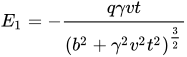
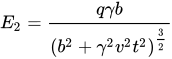

where indicates the component of the electric field in the direction of travel of the particle, indicates the E-field in the direction perpendicular to and in the plane of the collision, is the impact parameter, is the Lorentz factor, the charge and the velocity of the incident particle.


In the ultrarelativistic limit, and have the form of a pulse of radiation travelling in the direction. This creates the virtual radiation pulse (virtual quanta) denoted by . Moreover, an additional magnetic field may be added in order to turn into a radiation pulse travelling along , denoted . This virtual magnetic field will turn out to be much smaller than , hence its contribution to the motion of particles is minimal.[2]


By taking this point of view, the problem of the collision can be treated as a scattering of radiation. Similar analogies can be made for other processes (e.g. the ionisation of an atom by a fast electron can be treated as photoexcitation).
Bremsstrahlung
In the case of bremsstrahlung, the problem becomes one of the scattering of the virtual quanta in the nuclear Coulomb potential. This is a standard problem and the cross section of the scattering is known as the Thomson cross section:
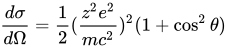
The differential radiation cross section per unit frequency is hence:

where is the frequency spectrum of virtual quanta produced by the incident particle over all possible impact parameters.[4]

Other applications
Synchrotron radiation
In the rest frame of the charged accelerating particle, the emission of synchrotron radiation can be treated as a Thomson scattering problem. This enables the introduction of various corrections into the classical calculation of the power lost by particles while accelerated, such as the quantum correction through the Klein-Nishina formula.[5]
Gravitational radiation
When transforming the gravitational field described by the Schwarzschild metric into the rest frame of a passing, relativistic test particle, an effect similar to the relativistic transformation of electric and magnetic fields is observed, and virtual pulses of gravitational radiation are produced. Through this, the cross section of close gravitational encounters and radiative power loss caused by such collisions can be calculated.[6]
References
- ^ Jackson 1999, p. 559
- ^ Jackson 1999, p. 726
- ^ Jackson 1999, p. 659
- ^ Jackson 1999, p. 730
- ^ Lieu; Axford; Quenby (1988). "Synchrotron radiation treated by the Weizsacker-Williams method of virtual quanta". Astronomy and Astrophysics. 208: 315–356. Retrieved 25 November 2022.
- ^ Matzner; Nutku (1973). "On the method of virtual quanta and gravitational radiation". Proceedings of the Royal Society of London. 336: 285–305. Retrieved 25 November 2022.
Bibliography
- Jackson, John David (1999). Classical Electrodynamics (3rd ed.). John Wiley & Sons. ISBN 0-471-30932-X.
Content Disclaimer
Informasi ini disarikan dari Wikipedia dan disajikan kembali untuk tujuan edukasi. Konten tersedia di bawah lisensi CC BY-SA 3.0. Kami tidak bertanggung jawab atas ketidakakuratan data yang bersumber dari kontribusi publik tersebut.
- The information displayed on this website is sourced in part or in whole from Wikipedia and has been adapted for the purpose of restating it. We strive to provide accurate and relevant information, however:
- There is no guarantee of absolute accuracy. Wikipedia is an open, collaborative project that can be edited by anyone, so information is subject to change.
- It is not intended to constitute professional advice. The content displayed is for informational and educational purposes only. For important decisions (e.g., medical, legal, or financial), please consult a professional.
- Content copyright. Wikipedia is licensed under the Creative Commons Attribution-ShareAlike License (CC BY-SA). This means that content may be reused with appropriate attribution and shared under a similar license.
- Responsible use. Any risk arising from the use of information from this website is entirely the responsibility of the user.