Hurwitz problem
In mathematics, the Hurwitz problem (named after Adolf Hurwitz) is the problem of finding multiplicative relations between quadratic forms which generalise those known to exist between sums of squares in certain numbers of variables.
Description
There are well-known multiplicative relationships between sums of squares in two variables

(known as the Brahmagupta–Fibonacci identity), and also Euler's four-square identity and Degen's eight-square identity. These may be interpreted as multiplicativity for the norms on the complex numbers (), quaternions (), and octonions (), respectively.[1]: 1–3 [2]


The Hurwitz problem for the field K is to find general relations of the form

with the z being bilinear forms in the x and y: that is, each z is a K-linear combination of terms of the form xi yj.[3]: 127
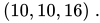
We call a triple admissible for K if such an identity exists.[1]: 125 Trivial cases of admissible triples include The problem is uninteresting for K of characteristic 2, since over such fields every sum of squares is a square, and we exclude this case. It is believed that otherwise admissibility is independent of the field of definition.[1]: 137


The Hurwitz–Radon theorem
Hurwitz posed the problem in 1898 in the special case and showed that, when coefficients are taken in , the only admissible values were [3]: 130 His proof extends to a field of any characteristic except 2.[1]: 3



The "Hurwitz–Radon" problem is that of finding admissible triples of the form Obviously is admissible. The Hurwitz–Radon theorem states that is admissible over any field where is the function defined for v odd, with and [1]: 137 [3]: 130





Other admissible triples include [1]: 138 and [1]: 137

See also
References
- ^ a b c d e f g Rajwade, A.R. (1993). Squares. London Mathematical Society Lecture Note Series. Vol. 171. Cambridge University Press. ISBN 0-521-42668-5. Zbl 0785.11022.
- ^ Curtis, C.W. (1963). "The four and eight square problem and division algebras". In Albert, A.A. (ed.). Studies in Modern Algebra. Mathematical Association of America. pp. 100–125, esp. 115. — Solution of Hurwitz's Problem on page 115.
- ^ a b c Lam, Tsit-Yuen (2005). Introduction to Quadratic Forms over Fields. Graduate Studies in Mathematics. Vol. 67. American Mathematical Society. ISBN 0-8218-1095-2. MR 2104929. Zbl 1068.11023.
Content Disclaimer
Informasi ini disarikan dari Wikipedia dan disajikan kembali untuk tujuan edukasi. Konten tersedia di bawah lisensi CC BY-SA 3.0. Kami tidak bertanggung jawab atas ketidakakuratan data yang bersumber dari kontribusi publik tersebut.
- The information displayed on this website is sourced in part or in whole from Wikipedia and has been adapted for the purpose of restating it. We strive to provide accurate and relevant information, however:
- There is no guarantee of absolute accuracy. Wikipedia is an open, collaborative project that can be edited by anyone, so information is subject to change.
- It is not intended to constitute professional advice. The content displayed is for informational and educational purposes only. For important decisions (e.g., medical, legal, or financial), please consult a professional.
- Content copyright. Wikipedia is licensed under the Creative Commons Attribution-ShareAlike License (CC BY-SA). This means that content may be reused with appropriate attribution and shared under a similar license.
- Responsible use. Any risk arising from the use of information from this website is entirely the responsibility of the user.