Hilbert–Samuel function
In commutative algebra the Hilbert–Samuel function, named after David Hilbert and Pierre Samuel,[1] of a nonzero finitely generated module over a commutative Noetherian local ring and a primary ideal of is the map such that, for all ,



where denotes the length over . It is related to the Hilbert function of the associated graded module by the identity


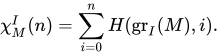
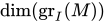
For sufficiently large , it coincides with a polynomial function of degree equal to , often called the Hilbert-Samuel polynomial (or Hilbert polynomial).[2]

Examples
For the ring of formal power series in two variables taken as a module over itself and the ideal generated by the monomials x2 and y3 we have
![{\displaystyle k[[x,y]]}](https://wikimedia.org/api/rest_v1/media/math/render/svg/ac7c20ba30a3d3487d56a835a6a467e95f48106d)

Degree bounds
Unlike the Hilbert function, the Hilbert–Samuel function is not additive on an exact sequence. However, it is still reasonably close to being additive, as a consequence of the Artin–Rees lemma. We denote by the Hilbert-Samuel polynomial; i.e., it coincides with the Hilbert–Samuel function for large integers.

Theorem—Let be a Noetherian local ring and I an m-primary ideal. If


is an exact sequence of finitely generated R-modules and if has finite length,[3] then we have:[4]


where F is a polynomial of degree strictly less than that of and having positive leading coefficient. In particular, if , then the degree of is strictly less than that of .


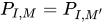
Proof: Tensoring the given exact sequence with and computing the kernel we get the exact sequence:


which gives us:
- .

The third term on the right can be estimated by Artin-Rees. Indeed, by the lemma, for large n and some k,

Thus,
- .

This gives the desired degree bound.
Multiplicity
If is a local ring of Krull dimension , with -primary ideal , its Hilbert polynomial has leading term of the form for some integer . This integer is called the multiplicity of the ideal . When is the maximal ideal of , one also says is the multiplicity of the local ring .


The multiplicity of a point of a scheme is defined to be the multiplicity of the corresponding local ring .


See also
References
- ^ H. Hironaka, Resolution of Singularities of an Algebraic Variety Over a Field of Characteristic Zero: I. Ann. of Math. 2nd Ser., Vol. 79, No. 1. (Jan., 1964), pp. 109-203.
- ^ a b Atiyah, M. F. and MacDonald, I. G. Introduction to Commutative Algebra. Reading, MA: Addison–Wesley, 1969.
- ^ This implies that and also have finite length.
- ^ Eisenbud, David, Commutative Algebra with a View Toward Algebraic Geometry, Graduate Texts in Mathematics, 150, Springer-Verlag, 1995, ISBN 0-387-94268-8. Lemma 12.3.


Content Disclaimer
Informasi ini disarikan dari Wikipedia dan disajikan kembali untuk tujuan edukasi. Konten tersedia di bawah lisensi CC BY-SA 3.0. Kami tidak bertanggung jawab atas ketidakakuratan data yang bersumber dari kontribusi publik tersebut.
- The information displayed on this website is sourced in part or in whole from Wikipedia and has been adapted for the purpose of restating it. We strive to provide accurate and relevant information, however:
- There is no guarantee of absolute accuracy. Wikipedia is an open, collaborative project that can be edited by anyone, so information is subject to change.
- It is not intended to constitute professional advice. The content displayed is for informational and educational purposes only. For important decisions (e.g., medical, legal, or financial), please consult a professional.
- Content copyright. Wikipedia is licensed under the Creative Commons Attribution-ShareAlike License (CC BY-SA). This means that content may be reused with appropriate attribution and shared under a similar license.
- Responsible use. Any risk arising from the use of information from this website is entirely the responsibility of the user.