HD 89998
| Observation data Epoch J2000 Equinox J2000 | |
|---|---|
| Constellation | Vela[1] |
| Right ascension | 10h 22m 19.58477s[2] |
| Declination | −41° 38′ 59.8592″[2] |
| Apparent magnitude (V) | 4.82[1] |
| Characteristics | |
| Spectral type | K1 III[3] |
| B−V color index | 1.095±0.055[1] |
| Astrometry | |
| Radial velocity (Rv) | +20.9±0.8[4] km/s |
| Proper motion (μ) | RA: −27.664[2] mas/yr Dec.: +60.090[2] mas/yr |
| Parallax (π) | 15.9154±0.1375 mas[2] |
| Distance | 205 ± 2 ly (62.8 ± 0.5 pc) |
| Absolute magnitude (MV) | 0.84[1] |
| Details | |
| Mass | 1.9[5] M☉ |
| Radius | 11.0[6] R☉ |
| Luminosity | 56[6] L☉ |
| Surface gravity (log g) | 2.77[5] cgs |
| Temperature | 4,761[6] K |
| Metallicity [Fe/H] | +0.12[5] dex |
| Rotational velocity (v sin i) | <1.0[7] km/s |
| Other designations | |
| r Vel, NSV 4837, CD−41°5809, FK5 1268, HD 89998, HIP 50799, HR 4080, SAO 221998[8] | |
| Database references | |
| SIMBAD | data |
HD 89998 (r Velorum) is a single[9] star in the southern constellation of Vela. It is a faint star but visible to the naked eye with an apparent visual magnitude of 4.82.[1] The distance to HD 89998, as determined from its annual parallax shift of 15.9 mas,[2] is 205 light years. The star is moving further from the Earth with a heliocentric radial velocity of +21 km/s,[4] having come within 140 ly some 1.552 million years ago.[1]
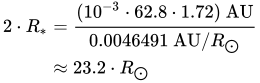
This is an evolved giant star with a stellar classification of K1 III.[3] The measured angular diameter of this star, after correcting for limb darkening, is 1.72±0.02 mas.[10] At the estimated distance of this star, this yields a physical size of 11.6 times the radius of the Sun.[11] It is radiating 56 times the Sun's luminosity from its enlarged photosphere at en effective temperature of 4,761 K.[6]
References
- ^ a b c d e f Anderson, E.; Francis, Ch. (2012). "XHIP: An extended hipparcos compilation". Astronomy Letters. 38 (5): 331. arXiv:1108.4971. Bibcode:2012AstL...38..331A. doi:10.1134/S1063773712050015. XHIP record for this object at VizieR.
- ^ a b c d e f Brown, A. G. A.; et al. (Gaia collaboration) (August 2018). "Gaia Data Release 2: Summary of the contents and survey properties". Astronomy & Astrophysics. 616. A1. arXiv:1804.09365. Bibcode:2018A&A...616A...1G. doi:10.1051/0004-6361/201833051. Gaia DR2 record for this source at VizieR.
- ^ a b Houk, Nancy (1978), Michigan catalogue of two-dimensional spectral types for the HD stars, vol. 2, Ann Arbor: Dept. of Astronomy, University of Michigan, Bibcode:1978mcts.book.....H.
- ^ a b de Bruijne, J. H. J.; Eilers, A.-C. (October 2012), "Radial velocities for the HIPPARCOS-Gaia Hundred-Thousand-Proper-Motion project", Astronomy & Astrophysics, 546: 14, arXiv:1208.3048, Bibcode:2012A&A...546A..61D, doi:10.1051/0004-6361/201219219, S2CID 59451347, A61.
- ^ a b c Khalatyan, A.; Anders, F.; Chiappini, C.; Queiroz, A. B. A.; Nepal, S.; Dal Ponte, M.; Jordi, C.; Guiglion, G.; Valentini, M.; Torralba Elipe, G.; Steinmetz, M.; Pantaleoni-González, M.; Malhotra, S.; Jiménez-Arranz, Ó.; Enke, H.; Casamiquela, L.; Ardèvol, J. (2024). "Transferring spectroscopic stellar labels to 217 million Gaia DR3 XP stars with SHBoost". Astronomy and Astrophysics. 691: A98. arXiv:2407.06963. Bibcode:2024A&A...691A..98K. doi:10.1051/0004-6361/202451427.
- ^ a b c d Hon, Marc; Huber, Daniel; Kuszlewicz, James S.; Stello, Dennis; Sharma, Sanjib; Tayar, Jamie; Zinn, Joel C.; Vrard, Mathieu; Pinsonneault, Marc H. (2021). "A "Quick Look" at All-sky Galactic Archeology with TESS: 158,000 Oscillating Red Giants from the MIT Quick-look Pipeline". The Astrophysical Journal. 919 (2): 131. arXiv:2108.01241. Bibcode:2021ApJ...919..131H. doi:10.3847/1538-4357/ac14b1.
- ^ De Medeiros, J. R.; Alves, S.; Udry, S.; Andersen, J.; Nordström, B.; Mayor, M. (2014). "A catalog of rotational and radial velocities for evolved stars. V. Southern stars". Astronomy and Astrophysics. 561: A126. arXiv:1312.3474. Bibcode:2014A&A...561A.126D. doi:10.1051/0004-6361/201220762.
- ^ "HD 85622". SIMBAD. Centre de données astronomiques de Strasbourg. Retrieved 2018-08-08.
- ^ Eggleton, P. P.; Tokovinin, A. A. (2008), "A catalogue of multiplicity among bright stellar systems", Monthly Notices of the Royal Astronomical Society, 389 (2): 869, arXiv:0806.2878, Bibcode:2008MNRAS.389..869E, doi:10.1111/j.1365-2966.2008.13596.x, S2CID 14878976.
- ^ Richichi, A.; et al. (February 2005), "CHARM2: An updated Catalog of High Angular Resolution Measurements", Astronomy and Astrophysics, 431 (2): 773–777, Bibcode:2005A&A...431..773R, doi:10.1051/0004-6361:20042039.
- ^ Lang, Kenneth R. (2006), Astrophysical formulae, Astronomy and astrophysics library, vol. 1 (3rd ed.), Birkhäuser, ISBN 3-540-29692-1. The radius (R*) is given by:
Content Disclaimer
Informasi ini disarikan dari Wikipedia dan disajikan kembali untuk tujuan edukasi. Konten tersedia di bawah lisensi CC BY-SA 3.0. Kami tidak bertanggung jawab atas ketidakakuratan data yang bersumber dari kontribusi publik tersebut.
- The information displayed on this website is sourced in part or in whole from Wikipedia and has been adapted for the purpose of restating it. We strive to provide accurate and relevant information, however:
- There is no guarantee of absolute accuracy. Wikipedia is an open, collaborative project that can be edited by anyone, so information is subject to change.
- It is not intended to constitute professional advice. The content displayed is for informational and educational purposes only. For important decisions (e.g., medical, legal, or financial), please consult a professional.
- Content copyright. Wikipedia is licensed under the Creative Commons Attribution-ShareAlike License (CC BY-SA). This means that content may be reused with appropriate attribution and shared under a similar license.
- Responsible use. Any risk arising from the use of information from this website is entirely the responsibility of the user.