Guillermo Laborde
Guillermo Laborde | |
|---|---|
 | |
| Born | October 24, 1886 |
| Died | May 13, 1940 (aged 53) Montevideo |
| Occupations | Painter, sculptor |
Guillermo Laborde (24 October 1886 – 13 May 1940) was an Uruguayan painter, sculptor and designer.
Biography
He received his first art lessons at the Círculo de Bellas Artes in Montevideo with Carlos María Herrera. After 1912, he studied in Florence, Rome, Paris and Spain; supported by a grant from the Uruguayan government. He returned to Montevideo in 1921 and, in 1923, began working as a teacher at the Escuela Industrial, the Círculo Fomento de Bellas Artes and the Institutos Normales de Montevideo.[1]
Together with José Cuneo Perinetti, Carmelo de Arzadun, Alfredo De Simone and Petrona Viera[2] he became one of the founders of the "Planismo" movement; named after their technique of painting in austere, geometric "planes" with bright colors. His portrait of the art critic, Luis Eduardo Pombo (1900-1976) is considered to be a prime example of that style.[3]
In addition to painting, he also created sculptures and graphic designs, as well as designs for costumes, theater and carnival sets. His best known design was the official poster for the first FIFA World Cup in 1930; which was awarded first prize in a competition held by the Centennial Commission.
He died suddenly after completing the set designs for a performance of La damnation de Faust, produced by SODRE.
Selected works
-
 Portrait of Petrona Viera
 -
 Still life
 -
 Portrait of Luis Eduardo Pombo
 -
 The Mirror
 -
 Self portrait
 -
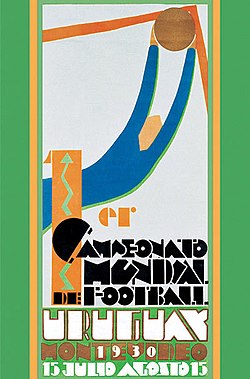 FIFA World Cup poster


References
External links

- Biographical notes and chronology @ Porton de San Pedro
- Guillermo Laborde in the Museo Nacional de Artes Visuales, Montevideo.
- Works by Laborde @ Anáforas

Content Disclaimer
Informasi ini disarikan dari Wikipedia dan disajikan kembali untuk tujuan edukasi. Konten tersedia di bawah lisensi CC BY-SA 3.0. Kami tidak bertanggung jawab atas ketidakakuratan data yang bersumber dari kontribusi publik tersebut.
- The information displayed on this website is sourced in part or in whole from Wikipedia and has been adapted for the purpose of restating it. We strive to provide accurate and relevant information, however:
- There is no guarantee of absolute accuracy. Wikipedia is an open, collaborative project that can be edited by anyone, so information is subject to change.
- It is not intended to constitute professional advice. The content displayed is for informational and educational purposes only. For important decisions (e.g., medical, legal, or financial), please consult a professional.
- Content copyright. Wikipedia is licensed under the Creative Commons Attribution-ShareAlike License (CC BY-SA). This means that content may be reused with appropriate attribution and shared under a similar license.
- Responsible use. Any risk arising from the use of information from this website is entirely the responsibility of the user.