Gebhart factor
The Gebhart factors are used in radiative heat transfer, it is a means to describe the ratio of radiation absorbed by any other surface versus the total emitted radiation from given surface. As such, it becomes the radiation exchange factor between a number of surfaces. The Gebhart factors calculation method is supported in several radiation heat transfer tools, such as TMG [1] and TRNSYS.
The method was introduced by Benjamin Gebhart in 1957.[2] Although a requirement is the calculation of the view factors beforehand, it requires less computational power, compared to using ray tracing with the Monte Carlo Method (MCM).[3] Alternative methods are to look at the radiosity, which Hottel [4] and others build upon.
Equations
The Gebhart factor can be given as:

.[4]
The Gebhart factor approach assumes that the surfaces are gray and emits and are illuminated diffusely and uniformly.[3]
This can be rewritten as:
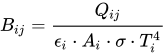
where
- is the Gebhart factor
- is the heat transfer from surface i to j
- is the emissivity of the surface
- is the surface area
- is the temperature


The denominator can also be recognized from the Stefan–Boltzmann law.
The factor can then be used to calculate the net energy transferred from one surface to all other, for an opaque surface given as:[2]

where
- is the net heat transfer for surface i

Looking at the geometric relation, it can be seen that:

This can be used to write the net energy transfer from one surface to another, here for 1 to 2:

Realizing that this can be used to find the heat transferred (Q), which was used in the definition, and using the view factors as auxiliary equation, it can be shown that the Gebhart factors are:[5]

where
- is the view factor for surface i to j

And also, from the definition we see that the sum of the Gebhart factors must be equal to 1.
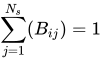
Several approaches exists to describe this as a system of linear equations that can be solved by Gaussian elimination or similar methods. For simpler cases it can also be formulated as a single expression.
See also
References
- ^ "Radiation" (PDF). SDRC. SDRC/APIC. 2000-01-01. Archived from the original (PDF) on 2012-03-15. Retrieved 2010-11-26.
- ^ a b B. Gebhart, "Surface temperature calculations in radiant surroundings of arbitrary complexity--for gray, diffuse radiation. International Journal of Heat and Mass Transfer".
- ^ a b Chin, J. H., Panczak, T. D. and Fried, L. (1992), "Spacecraft thermal modeling. International Journal for Numerical Methods in Engineering".
- ^ a b Korybalski, Michael E. Clark, John A. (John Alden), "Algebraic Methods for the Calculation of Radiation Exchange in an Enclosure"
- ^ D. E. BORNSIDE, T. A. KINNEY AND R. A. BROWN, "Finite element/Newton method for the analysis of Czochralski crystal growth with diffuse-grey radiative heat transfer . International Journal for Numerical Methods in Engineering".
Content Disclaimer
Informasi ini disarikan dari Wikipedia dan disajikan kembali untuk tujuan edukasi. Konten tersedia di bawah lisensi CC BY-SA 3.0. Kami tidak bertanggung jawab atas ketidakakuratan data yang bersumber dari kontribusi publik tersebut.
- The information displayed on this website is sourced in part or in whole from Wikipedia and has been adapted for the purpose of restating it. We strive to provide accurate and relevant information, however:
- There is no guarantee of absolute accuracy. Wikipedia is an open, collaborative project that can be edited by anyone, so information is subject to change.
- It is not intended to constitute professional advice. The content displayed is for informational and educational purposes only. For important decisions (e.g., medical, legal, or financial), please consult a professional.
- Content copyright. Wikipedia is licensed under the Creative Commons Attribution-ShareAlike License (CC BY-SA). This means that content may be reused with appropriate attribution and shared under a similar license.
- Responsible use. Any risk arising from the use of information from this website is entirely the responsibility of the user.