G equation
In Combustion, G equation is a scalar field equation which describes the instantaneous flame position, introduced by Forman A. Williams in 1985[1][2] in the study of premixed turbulent combustion. The equation is derived based on the Level-set method. The equation was first studied by George H. Markstein, in a restrictive form for the burning velocity and not as a level set of a field.[3][4][5] The G equation reads[6]


where is the flow density, is the flow velocity and is the normal mass flux entering any particular level set constant.


Mathematical description

where
- is the flow velocity field,
- is the local burning velocity with respect to the unburnt gas with density .


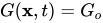
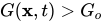
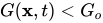
The flame location is given by which can be defined arbitrarily such that is the region of burnt gas and is the region of unburnt gas. The normal vector to the flame, pointing towards the burnt gas, is .

The G equation has the form of the Hamilton-Jacobi equation, an equation in analytical mechanics used to model particle dynamics as propagation of waves.[9][10]
Local burning velocity
According to Matalon–Matkowsky–Clavin–Joulin theory, the burning velocity of the stretched flame, for small curvature and small strain, is given by

where
- is the burning velocity of unstretched flame with respect to the unburnt gas
- and are the two Markstein numbers, associated with the curvature and tangential straining; is the surface divergence of the tangential velocity
- is the laminar flame thickness.


A simple example - Slot burner

The G equation has an exact expression for a simple slot burner. Consider a two-dimensional planar slot burner of slot width . The premixed reactant mixture is fed through the slot from the bottom with a constant velocity , where the coordinate is chosen such that lies at the center of the slot and lies at the location of the mouth of the slot. When the mixture is ignited, a premixed flame develops from the mouth of the slot to a certain height in the form of a two-dimensional wedge shape with a wedge angle . For simplicity, let us assume , which is a good approximation except near the wedge corner where curvature effects will becomes important. In the steady case, the G equation reduces to


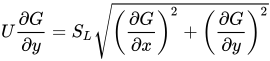
If a separation of the form is introduced, then the equation becomes


which upon integration gives

Without loss of generality choose the flame location to be at . Since the flame is attached to the mouth of the slot , the boundary condition is , which can be used to evaluate the constant . Thus the scalar field is


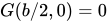


At the flame tip, we have , which enable us to determine the flame height


and the flame angle ,

Using the trigonometric identity , we have


In fact, the above formula is often used to determine the planar burning speed , by measuring the wedge angle.
References
- ^ Williams, F. A. (1985). Turbulent combustion. In The mathematics of combustion (pp. 97-131). Society for Industrial and Applied Mathematics.
- ^ Kerstein, Alan R., William T. Ashurst, and Forman A. Williams. "Field equation for interface propagation in an unsteady homogeneous flow field." Physical Review A 37.7 (1988): 2728.
- ^ GH Markstein. (1951). Interaction of flow pulsations and flame propagation. Journal of the Aeronautical Sciences, 18(6), 428-429.
- ^ Markstein, G. H. (Ed.). (2014). Nonsteady flame propagation: AGARDograph (Vol. 75). Elsevier.
- ^ Markstein, G. H., & Squire, W. (1955). On the stability of a plane flame front in oscillating flow. The Journal of the Acoustical Society of America, 27(3), 416-424.
- ^ Rajamanickam, P., & Daou, J. (2024). Hydrodynamic theory of premixed flames under Darcy's law. Physics of Fluids, 36(12).
- ^ Peters, Norbert. Turbulent combustion. Cambridge university press, 2000.
- ^ Williams, Forman A. "Combustion theory." (1985).
- ^ Xin, J.; Yu, Y.; Ronney, P. Lagrangian, Game Theoretic and PDE Methods for Averaging G-equations in Turbulent Combustion: Existence and Beyond. arXiv:2401.14575 [math.AP], 2024.
- ^ G. Pagnini, R. A. D. Akkermans, N. Buchmann, A. Mentrelli, Reaction-Diffusion Equation and G-Equation Approaches Reconciled in Turbulent Premixed Combustion Modelling, XXXVIII Meeting of the Italian Section of the Combustion Institute, BCAM – Basque Center for Applied Mathematics (Bilbao, Spain); Technical University of Braunschweig (Germany); University of Bologna (Italy).
Content Disclaimer
Informasi ini disarikan dari Wikipedia dan disajikan kembali untuk tujuan edukasi. Konten tersedia di bawah lisensi CC BY-SA 3.0. Kami tidak bertanggung jawab atas ketidakakuratan data yang bersumber dari kontribusi publik tersebut.
- The information displayed on this website is sourced in part or in whole from Wikipedia and has been adapted for the purpose of restating it. We strive to provide accurate and relevant information, however:
- There is no guarantee of absolute accuracy. Wikipedia is an open, collaborative project that can be edited by anyone, so information is subject to change.
- It is not intended to constitute professional advice. The content displayed is for informational and educational purposes only. For important decisions (e.g., medical, legal, or financial), please consult a professional.
- Content copyright. Wikipedia is licensed under the Creative Commons Attribution-ShareAlike License (CC BY-SA). This means that content may be reused with appropriate attribution and shared under a similar license.
- Responsible use. Any risk arising from the use of information from this website is entirely the responsibility of the user.