Feynman's algorithm
Feynman's algorithm is an algorithm that is used to simulate the operations of a quantum computer on a classical computer. It is based on the Path integral formulation of quantum mechanics, which was formulated by Richard Feynman.[1]
Overview
An qubit quantum computer takes in a quantum circuit that contains gates and an input state . It then outputs a string of bits with probability .



In Schrödinger's algorithm, is calculated straightforwardly via matrix multiplication. That is, . The quantum state of the system can be tracked throughout its evolution.[2]


In Feynman's path algorithm, is calculated by summing up the contributions of histories. That is, . [3]


Schrödinger's takes less time to run compared to Feynman's while Feynman's takes more time and less space. More precisely, Schrödinger's takes time and space while Feynman's takes time and space.[4]


Example
Consider the problem of creating a Bell state. What is the probability that the resulting measurement will be ?

Since the quantum circuit that generates a Bell state is the H (Hadamard gate) gate followed by the CNOT gate, the unitary for this circuit is . In that case, using Schrödinger's algorithm. So probability resulting measurement will be is .



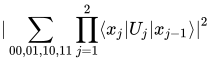
Using Feynman's algorithm, the Bell state circuit contains histories: . So = | + + + .






See also
References
- ^ Ethan Bernstein and Umesh Vazirani (1997). "Quantum Complexity Theory". SIAM Journal on Computing. 26 (5): 1411–1473. doi:10.1137/S0097539796300921.
- ^ Raedt, K. De; Michielsen, K.; Raedt, H. De; Trieu, B.; Lippert, Th.; Watanabe, H.; Ito, N. (2006). "Massively parallel quantum computer simulator". Comput. Phys. Commun. 176 (2): 121–136. arXiv:quant-ph/0608239. doi:10.1016/j.cpc.2006.08.007. S2CID 17463164.
- ^ Rudiak-Gould, Ben (2006). "The sum-over-histories formulation of quantum computing". arXiv:quant-ph/0607151.
- ^ Aaronson, Scott; Chen, Lijie (2017). Complexity-Theoretic Foundations of Quantum Supremacy Experiments. Vol. 79. Schloss Dagstuhl – Leibniz-Zentrum für Informatik. pp. 1–67. arXiv:1612.05903. doi:10.4230/LIPIcs.CCC.2017.22. ISBN 9783959770408. S2CID 12591414.
Content Disclaimer
Informasi ini disarikan dari Wikipedia dan disajikan kembali untuk tujuan edukasi. Konten tersedia di bawah lisensi CC BY-SA 3.0. Kami tidak bertanggung jawab atas ketidakakuratan data yang bersumber dari kontribusi publik tersebut.
- The information displayed on this website is sourced in part or in whole from Wikipedia and has been adapted for the purpose of restating it. We strive to provide accurate and relevant information, however:
- There is no guarantee of absolute accuracy. Wikipedia is an open, collaborative project that can be edited by anyone, so information is subject to change.
- It is not intended to constitute professional advice. The content displayed is for informational and educational purposes only. For important decisions (e.g., medical, legal, or financial), please consult a professional.
- Content copyright. Wikipedia is licensed under the Creative Commons Attribution-ShareAlike License (CC BY-SA). This means that content may be reused with appropriate attribution and shared under a similar license.
- Responsible use. Any risk arising from the use of information from this website is entirely the responsibility of the user.