Fekete problem
In mathematics, the Fekete problem is, given a natural number N and a real s ≥ 0, to find the points x1,...,xN on the 2-sphere for which the s-energy, defined by
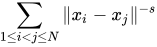
for s > 0 and by
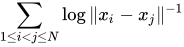
for s = 0, is minimal. For s > 0, such points are called s-Fekete points, and for s = 0, logarithmic Fekete points (see Saff & Kuijlaars (1997)). More generally, one can consider the same problem on the d-dimensional sphere, or on a Riemannian manifold (in which case ||xi −xj|| is replaced with the Riemannian distance between xi and xj).
The problem originated in the paper by Michael Fekete (1923) who considered the one-dimensional, s = 0 case, answering a question of Issai Schur.
An algorithmic version of the Fekete problem is number 7 on the list of problems discussed by Smale (1998).
References
- Bendito, E.; Carmona, A.; Encinas, A. M.; Gesto, J. M.; Gómez, A.; Mouriño, C.; Sánchez, M. T. (2009), "Computational cost of the Fekete problem. I. The forces method on the 2-sphere", Journal of Computational Physics, 228 (9): 3288–3306, Bibcode:2009JCoPh.228.3288B, doi:10.1016/j.jcp.2009.01.021, ISSN 0021-9991, MR 2513833
- Fekete, M. (1923), "Über die Verteilung der Wurzeln bei gewissen algebraischen Gleichungen mit ganzzahligen Koeffizienten", Mathematische Zeitschrift, 17 (1): 228–249, doi:10.1007/BF01504345, ISSN 0025-5874, MR 1544613, S2CID 186223729
- Saff, E. B.; Kuijlaars, A. B. J. (1997). "Distributing many points on a sphere". Math. Intelligencer. 19 (1): 5–11. doi:10.1007/BF03024331. MR 1439152. S2CID 122562170.
- Smale, Stephen (1998), "Mathematical problems for the next century", The Mathematical Intelligencer, 20 (2): 7–15, doi:10.1007/BF03025291, ISSN 0343-6993, MR 1631413, S2CID 1331144
Content Disclaimer
Informasi ini disarikan dari Wikipedia dan disajikan kembali untuk tujuan edukasi. Konten tersedia di bawah lisensi CC BY-SA 3.0. Kami tidak bertanggung jawab atas ketidakakuratan data yang bersumber dari kontribusi publik tersebut.
- The information displayed on this website is sourced in part or in whole from Wikipedia and has been adapted for the purpose of restating it. We strive to provide accurate and relevant information, however:
- There is no guarantee of absolute accuracy. Wikipedia is an open, collaborative project that can be edited by anyone, so information is subject to change.
- It is not intended to constitute professional advice. The content displayed is for informational and educational purposes only. For important decisions (e.g., medical, legal, or financial), please consult a professional.
- Content copyright. Wikipedia is licensed under the Creative Commons Attribution-ShareAlike License (CC BY-SA). This means that content may be reused with appropriate attribution and shared under a similar license.
- Responsible use. Any risk arising from the use of information from this website is entirely the responsibility of the user.