Dirichlet density
In mathematics, the Dirichlet density (or analytic density) of a set of primes, named after Peter Gustav Lejeune Dirichlet, is a measure of the size of the set that is easier to use than the natural density.
Definition
If A is a subset of the prime numbers, the Dirichlet density of A is the limit
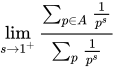
if it exists. Note that since as (see Prime zeta function), this is also equal to
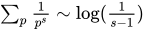

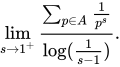
This expression is usually the order of the "pole" of

at s = 1, (though in general it is not really a pole as it has non-integral order), at least if this function is a holomorphic function times a (real) power of s−1 near s = 1. For example, if A is the set of all primes, it is the Riemann zeta function which has a pole of order 1 at s = 1, so the set of all primes has Dirichlet density 1.
More generally, one can define the Dirichlet density of a sequence of primes (or prime powers), possibly with repetitions, in the same way.
Properties
If a subset of primes A has a natural density, given by the limit of
- (number of elements of A less than N)/(number of primes less than N)
then it also has a Dirichlet density, and the two densities are the same. However it is usually easier to show that a set of primes has a Dirichlet density, and this is good enough for many purposes. For example, in proving Dirichlet's theorem on arithmetic progressions, it is easy to show that the set of primes in an arithmetic progression a + nb (for a, b coprime) has Dirichlet density 1/φ(b), which is enough to show that there are an infinite number of such primes, but harder to show that this is the natural density.
Roughly speaking, proving that some set of primes has a non-zero Dirichlet density usually involves showing that certain L-functions do not vanish at the point s = 1, while showing that they have a natural density involves showing that the L-functions have no zeros on the line Re(s) = 1.
In practice, if some "naturally occurring" set of primes has a Dirichlet density, then it also has a natural density, but it is possible to find artificial counterexamples: for example, the set of primes whose first decimal digit is 1 has no natural density, but has Dirichlet density log(2)/log(10).[1]
See also
Notes
- ^ This is attributed by J.-P. Serre to a private communication from Bombieri in A course in arithmetic; an elementary proof based on the prime number theorem is given in: A. Fuchs, G. Letta, Le problème du premier chiffre décimal pour les nombres premiers [The first digit problem for primes] (French) The Foata Festschrift. Electron. J. Combin. 3 (1996), no. 2.
References
- J.-P. Serre, A course in arithmetic, ISBN 0-387-90040-3, chapter VI section 4.
Content Disclaimer
Informasi ini disarikan dari Wikipedia dan disajikan kembali untuk tujuan edukasi. Konten tersedia di bawah lisensi CC BY-SA 3.0. Kami tidak bertanggung jawab atas ketidakakuratan data yang bersumber dari kontribusi publik tersebut.
- The information displayed on this website is sourced in part or in whole from Wikipedia and has been adapted for the purpose of restating it. We strive to provide accurate and relevant information, however:
- There is no guarantee of absolute accuracy. Wikipedia is an open, collaborative project that can be edited by anyone, so information is subject to change.
- It is not intended to constitute professional advice. The content displayed is for informational and educational purposes only. For important decisions (e.g., medical, legal, or financial), please consult a professional.
- Content copyright. Wikipedia is licensed under the Creative Commons Attribution-ShareAlike License (CC BY-SA). This means that content may be reused with appropriate attribution and shared under a similar license.
- Responsible use. Any risk arising from the use of information from this website is entirely the responsibility of the user.