CxK
 | This article needs additional citations for verification. (January 2023) |
| CxK (train) | |
|---|---|
 | |
| In service | 2003–present |
| Manufacturer | CAF |
| Number built |
|
| Operators | |
| Specifications | |
| Maximum speed |
|
| Electric system | EMU: 25 kV 50 Hz AC |
| Track gauge | |
CxK is an unofficial name given to a family of multiple unit trains produced by CAF for Ireland and Auckland. There are four types in operation, and they are the main suburban and commuter trains in Ireland. The name derives from NI Railways "C3K" and "C4K" classes.
Northern Ireland

NI Railways, the state-owned rail operator in Northern Ireland, has fully replaced its fleet of DEMUs with CxK types.
Class 3000
The Class 3000 was the first new train type purchased by NIR for two decades, to replace the increasingly obsolete NIR Class 80 units that had been in service since the mid-1970s.[1] The £80m order, the largest in NIR's history at that point, was signed in 2002, with the first unit delivered in 2004. The 23 three-car units enabled NIR to withdraw most Class 80 units. It is the main passenger train type in Northern Ireland, and operates on most routes. The first six units have CAWS to allow operation in the Republic of Ireland.
Class 4000
The Class 4000 is a follow-on from the C3K. Purchased in 2009, with the first unit delivered in 2011, the 20 three-car units replaced the 13 remaining Class 80 and Class 450 sets, allowing for major service enhancements.[2] NI Railways has an option to purchase 20 trailers to lengthen these units. In 2018, NI Railways announced a £66million order to purchase 21 new intermediate coaches to lengthen 7 of their Class 4000 units from 3 to 6 cars to help relieve capacity constraints on the Derry/Londonderry and Portadown Lines. The first 3 carriages arrived in March 2021, with all units entering service by January 2022.[3]
Republic of Ireland
29000 Class
The 29000 Class is the primary commuter train type operated by Iarnród Éireann, the state rail operator in the Republic of Ireland. Originally Class 2900, they are four-car units primarily used on commuter services around Dublin. The first batch of 20 units was delivered in 2002–2003, a further nine in 2005.
New Zealand
AM class
The 72 Auckland three-car AM class EMUs carry 373 passengers, and were delivered in three batches, the first batch over 2013-2015, the second batch over 2019-2020, and the third batch over 2024-2026.
The third batch of 23 EMUs are currently being introduced into service. As of 9th April 2026, 22 out of 23 Batch 3 EMUs have entered service, with the remaining unit undergoing final testing. The 3rd batch were ordered as part of the new City Rail Link project, due to open in the 2nd half of 2026.
The AM class EMUs run on 25kV overhead wire, and have a top speed of 110Km/h. They often run as 3-car sets off-peak, and 6-car sets (2 3-car sets coupled) during peak on the Auckland Metro Network.
The AM class use ETCS Level 1 as their primary train protection system. They are currently the only type in New Zealand operating under ETCS. This allows the AM class to operate under Automatic Train Operation (ATO), although this is currently only in the testing stage.
Gallery
-
 Class 3000 at Lisburn
 -
 Class 4000 approaching Magheramorne
 -
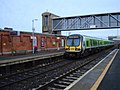 29000 Class departing Drumcondra
 -
 AM class at Wiri Depot in 2013

_-_geograph.org.uk_-_2924803.jpg)


References
- ^ New trains to boost rail network BBC News
- ^ "Regional Development Minister welcomes draft Budget allocations". Northernireland.gov.uk. Archived from the original on 20 May 2011. Retrieved 13 September 2010.
- ^ McLaughlin, Sophie (30 September 2021). "In Pictures: Take a look at Translink's new longer walk-through train". Belfast Live. Retrieved 23 July 2025.
External links
Content Disclaimer
Informasi ini disarikan dari Wikipedia dan disajikan kembali untuk tujuan edukasi. Konten tersedia di bawah lisensi CC BY-SA 3.0. Kami tidak bertanggung jawab atas ketidakakuratan data yang bersumber dari kontribusi publik tersebut.
- The information displayed on this website is sourced in part or in whole from Wikipedia and has been adapted for the purpose of restating it. We strive to provide accurate and relevant information, however:
- There is no guarantee of absolute accuracy. Wikipedia is an open, collaborative project that can be edited by anyone, so information is subject to change.
- It is not intended to constitute professional advice. The content displayed is for informational and educational purposes only. For important decisions (e.g., medical, legal, or financial), please consult a professional.
- Content copyright. Wikipedia is licensed under the Creative Commons Attribution-ShareAlike License (CC BY-SA). This means that content may be reused with appropriate attribution and shared under a similar license.
- Responsible use. Any risk arising from the use of information from this website is entirely the responsibility of the user.