Clearing factor
In centrifugation the clearing factor or k factor represents the relative pelleting efficiency of a given centrifuge rotor at maximum rotation speed. It can be used to estimate the time (in hours) required for sedimentation of a fraction with a known sedimentation coefficient (in svedbergs):


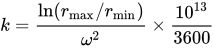
The value of the clearing factor depends on the maximum angular velocity of a centrifuge (in rad/s) and the minimum and maximum radius of the rotor:


As the rotational speed of a centrifuge is usually specified in RPM, the following formula is often used for convenience:[1]
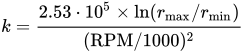
Centrifuge manufacturers usually specify the minimum, maximum and average radius of a rotor, as well as the factor of a centrifuge-rotor combination.

For runs with a rotational speed lower than the maximum rotor-speed, the factor has to be adjusted:
- 2

The K-factor is related to the sedimentation coefficient by the formula:


Where is the time to pellet a certain particle in hours. Since is a constant for a certain particle, this relationship can be used to interconvert between different rotors.


Where is the time to pellet in one rotor, and is the K-factor of that rotor. is the K-factor of the other rotor, and , the time to pellet in the other rotor, can be calculated. In this manner, one does not need access to the exact rotor cited in a protocol, as long as the K-factor can be calculated. Many online calculators are available to perform the calculations for common rotors.


References
External links
- Beckman Coulter lab resources and manuals
- Appendix F of the Cell Biology Laboratory Manual
 | This fluid dynamics–related article is a stub. You can help Wikipedia by adding missing information. |
Content Disclaimer
Informasi ini disarikan dari Wikipedia dan disajikan kembali untuk tujuan edukasi. Konten tersedia di bawah lisensi CC BY-SA 3.0. Kami tidak bertanggung jawab atas ketidakakuratan data yang bersumber dari kontribusi publik tersebut.
- The information displayed on this website is sourced in part or in whole from Wikipedia and has been adapted for the purpose of restating it. We strive to provide accurate and relevant information, however:
- There is no guarantee of absolute accuracy. Wikipedia is an open, collaborative project that can be edited by anyone, so information is subject to change.
- It is not intended to constitute professional advice. The content displayed is for informational and educational purposes only. For important decisions (e.g., medical, legal, or financial), please consult a professional.
- Content copyright. Wikipedia is licensed under the Creative Commons Attribution-ShareAlike License (CC BY-SA). This means that content may be reused with appropriate attribution and shared under a similar license.
- Responsible use. Any risk arising from the use of information from this website is entirely the responsibility of the user.