Checkerboard score
 | This article relies largely or entirely on a single source. (September 2013) |
In biodiversity studies, the checkerboard score or C-score is a statistic which determines the randomness of the distribution of two or more species through a collection of biomes. The statistic, first published by Stone and Roberts in 1990,[1] expands on the earlier work of Diamond[2] that defined a notion of "checkerboard distributions" as an indicator of species competition.
A low c-score indicates a higher randomness, i.e. a greater likelihood that the distribution of one species has not been directly affected by the presence of other species.
Definition and calculation
Given two species sp1, sp2 and n islands, an incident matrix is built. In the incident matrix, each row represents one of the two species and each column represents a different island. The matrix is then filled with each cell being set to either 0 or 1. Cell with the value of 0 means that a given species doesn't exist in the given island whilst the value of 1 means that the species do exist in the given island.

The calculation of the co-occurrence of two species sp1, sp2 in the given set of islands is done as follows:

- Cij - C-score for the two species sp1, sp2 in the given set of islands
- Sij - The number of co-occurrences of sp1, sp2
- ri - Number of islands in which sp1 has 1
- rj - Number of islands in which sp2 has 1
The checkerboard score (c-score) for the colonisation pattern is then calculated as the mean number of checkerboard units per species-pair in the community:
For M species, there are P = M(M-1)/2 species-pairs, so C-score is calculated:
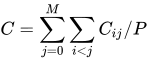
The C-score is sensitive to the proportion of islands that are occupied, thereby confounding comparisons between matrices or sets of species pairs within them. An extension of the C-score therefore standardizes by the number of islands each species-pair occupies using:[3]

References
- ^ Stone, Lewis; Roberts, Alan (1990). "The checkerboard score and species distributions". Oecologia. 85 (1): 74–79. Bibcode:1990Oecol..85...74S. doi:10.1007/BF00317345. ISSN 0029-8549. PMID 28310957. S2CID 14197156.
- ^ Diamond, JM (1975). "Assembly of species communities". In Cody, ML; Diamond, JM (eds.). Ecology and evolution of communities. Belknap Press. pp. 342–444. ISBN 978-0-674-22444-5.
- ^ Novak, Mark; Moore, Jonathan W.; Leidy, Robert A. (2011). "Nestedness patterns and the dual nature of community reassembly in California streams: a multivariate permutation-based approach". Global Change Biology. 17 (12): 3714–3723. Bibcode:2011GCBio..17.3714N. doi:10.1111/j.1365-2486.2011.02482.x. S2CID 15142785.
Content Disclaimer
Informasi ini disarikan dari Wikipedia dan disajikan kembali untuk tujuan edukasi. Konten tersedia di bawah lisensi CC BY-SA 3.0. Kami tidak bertanggung jawab atas ketidakakuratan data yang bersumber dari kontribusi publik tersebut.
- The information displayed on this website is sourced in part or in whole from Wikipedia and has been adapted for the purpose of restating it. We strive to provide accurate and relevant information, however:
- There is no guarantee of absolute accuracy. Wikipedia is an open, collaborative project that can be edited by anyone, so information is subject to change.
- It is not intended to constitute professional advice. The content displayed is for informational and educational purposes only. For important decisions (e.g., medical, legal, or financial), please consult a professional.
- Content copyright. Wikipedia is licensed under the Creative Commons Attribution-ShareAlike License (CC BY-SA). This means that content may be reused with appropriate attribution and shared under a similar license.
- Responsible use. Any risk arising from the use of information from this website is entirely the responsibility of the user.