Binade

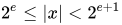
In software engineering and numerical analysis, a binade is a set of numbers in a binary floating-point format that all have the same sign and exponent. In other words, a binade is the interval or for some integer value , that is, the set of real numbers or floating-point numbers of the same sign such that .[1][2][3]

![{\displaystyle (-2^{e+1},-2^{e}]}](https://wikimedia.org/api/rest_v1/media/math/render/svg/2dab604433186c72682d254fb566597ee2ebfc6b)


Some authors use the convention of the closed interval instead of a half-open interval,[4] sometimes using both conventions in a single paper.[5] Some authors additionally treat each of various special quantities such as NaN, infinities, and zeroes as its own binade,[6] or similarly for the exceptional interval of subnormal numbers.[7]
![{\displaystyle [2^{e},2^{e+1}]}](https://wikimedia.org/api/rest_v1/media/math/render/svg/5f97150e6e73a3df500fee39d0e65fbfb0374102)

See also
References
- ^ Muller, Jean-Michel; Brunie, Nicolas; de Dinechin, Florent; Jeannerod, Claude-Pierre; Joldes, Mioara; Lefèvre, Vincent; Melquiond, Guillaume; Revol, Nathalie; Torres, Serge (2018). Handbook of Floating-Point Arithmetic (2nd ed.). Birkhäuser. pp. 418–419. doi:10.1007/978-3-319-76526-6. ISBN 978-3-319-76525-9.
- ^ Lefèvre, Vincent; Muller, Jean-Michel (2001). "Worst cases for correct rounding of the elementary functions in double precision" (PDF). 15th IEEE Symposium on Computer Arithmetic. ARITH 2001. IEEE. pp. 111–118. doi:10.1109/ARITH.2001.930110. ISSN 1063-6889.
- ^ Benet, Luis; Ferranti, Luca; Revol, Nathalie (2023). "A framework to test interval arithmetic libraries and their IEEE 1788-2015 compliance". Concurrency and Computation: Practice and Experience. 36 e7856. arXiv:2307.06953. doi:10.1002/cpe.7856. ISSN 1532-0626.
- ^ Coonen, Jerome T. (1981). "Underflow and the Denormalized Numbers". Computer. 14 (3). IEEE: 75–87. doi:10.1109/C-M.1981.220382. ISSN 0018-9162.
- ^ Hanrot, Guillaume; Lefèvre, Vincent; Stehlé, Damien; Zimmermann, Paul (2007). "Worst Cases of a Periodic Function for Large Arguments". 18th IEEE Symposium on Computer Arithmetic. ARITH 2007. pp. 133–140. doi:10.1109/ARITH.2007.37. ISSN 1063-6889.
- ^ Thomas, David B. (2015). "A general-purpose method for faithfully rounded floating-point function approximation in FPGAs". 22nd IEEE Symposium on Computer Arithmetic. ARITH 2015. pp. 42–49. doi:10.1109/ARITH.2015.27. ISSN 1063-6889.
- ^ Agrawal, Ankur; Mueller, Sylvia M.; Fleischer, Bruce M.; Choi, Jungwook; Wang, Naigang; Sun, Xiao; Gopalakrishnan, Kailash (2019). "DLFloat: A 16-b Floating Point format designed for Deep Learning Training and Inference". 26th IEEE Symposium on Computer Arithmetic. ARITH 2019. pp. 92–95. doi:10.1109/ARITH.2019.00023. ISSN 1063-6889.
Content Disclaimer
Informasi ini disarikan dari Wikipedia dan disajikan kembali untuk tujuan edukasi. Konten tersedia di bawah lisensi CC BY-SA 3.0. Kami tidak bertanggung jawab atas ketidakakuratan data yang bersumber dari kontribusi publik tersebut.
- The information displayed on this website is sourced in part or in whole from Wikipedia and has been adapted for the purpose of restating it. We strive to provide accurate and relevant information, however:
- There is no guarantee of absolute accuracy. Wikipedia is an open, collaborative project that can be edited by anyone, so information is subject to change.
- It is not intended to constitute professional advice. The content displayed is for informational and educational purposes only. For important decisions (e.g., medical, legal, or financial), please consult a professional.
- Content copyright. Wikipedia is licensed under the Creative Commons Attribution-ShareAlike License (CC BY-SA). This means that content may be reused with appropriate attribution and shared under a similar license.
- Responsible use. Any risk arising from the use of information from this website is entirely the responsibility of the user.