Annona Chalk
| Annona Chalk | |
|---|---|
| Stratigraphic range: Cretaceous | |
 Outcrop east of Clarksville, TX (c. 1910) | |
| Type | Sedimentary |
| Sub-units | Austin Group |
| Underlies | Marlbrook Marl |
| Overlies | Ozan Formation |
| Thickness | 30 Meters |
| Lithology | |
| Primary | Chalk |
| Location | |
| Region | Arkansas |
| Country | United States |
| Type section | |
| Named for | Annona, Red River County, Texas[1] |
| Named by | Robert Thomas Hill |
The Annona Chalk is a geologic formation in Arkansas, Texas, Louisiana, and Oklahoma.[2] It preserves fossils dating back to the Cretaceous period. The formation is a hard, thick-bedded to massive, slightly fossiliferous chalk. It weathers white, but is blue-gray when freshly exposed. The unit is commercially mined for cement. Fossils in the Annona Chalk include coelenterates, echinoderms, annelids, bivalves, gastropods, cephalopods, and some vertebrate traces.[3] The beds range in thickness, up to over 100 feet in depth in some areas (such as at White Cliffs).,[4] but thins to the east and is only a few feet thick north of Columbus, Arkansas and is completely missing to the east. The break between the Annona Formation and the Ozan Formation appears to be sharp with a few tubular borings up to a foot long extending down from the Annona in to the Ozan.[5]
Exposures
-
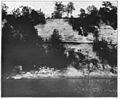 Annona Chalk overlying Ozan Formation at what is now called White Cliffs Natural Area, with the Little River in the foreground, Howard County, AR (c. 1910)
 -
 Another view of the same location (c. 1902)
 -
 Quarry at Whitecliffs Landing (c. 1902)


Paleofauna
- N. (Nostoceras) danei[6]
- N. (Nostoceras) monotuberculatum[6]
- N. (Nostoceras) plerucostatum[6]
- N. (Nostoceras) pulcher[6]
- O. crassum[6]
- A. ponderosana[7]
- B. rotunda[7]
- B. ovata[7]
- B. windhami[7]
- C. blakei[7]
- K. cushmani[7]
- L. fletcheri[7]
- O. hannai[7]
- P. texanus[7]
- V. ozanana[7]
See also

References
- ^ Hill, R.T. (1894). "Geology of parts of Texas, Indian Territory and Arkansas adjacent to Red River". Bulletin of the Geological Society of America. 5: 308.
- ^ USGS Geolex, Annona Chalk/Formation
- ^ R. T. Hill. "Annona Chalk Formation". Arkansas Geological Survey. Arkansas Geological Survey. p. 308. Archived from the original on May 27, 2010. Retrieved 25 May 2015.
- ^ Veatch, Arthur Clifford (1906). Geology and Underground Water Resources of Northern Louisiana and Southern Arkansas. U.S. Government Printing Office.
- ^ Dane, 1929, Upper Cretaceous Formations of Southwestern Arkansas, Arkansas Geological Survey Bulletin 1
- ^ a b c d e f g h i j k l Kennedy, W. J.; Cobban, W. A. (1993). "Campanian ammonites from the Annona Chalk near Yancy, Arkansas". Journal of Paleontology. 67 (1): 83–97.
- ^ a b c d e f g h i j k l m n o p q r s t u v w x y Collins, Jr., Robert J. (June 1960). Stratigraphy and Ostracoda of the Ozan, Annona, and Marlbrook Formations of southwestern Arkansas (PhD). Louisiana State University and Agricultural and Mechanical College.
- Various Contributors to the Paleobiology Database. "Fossilworks: Gateway to the Paleobiology Database". Retrieved 17 December 2021.
- Notes on the Annona Chalk, Norman L. Thomas and Elmer M. Rice, Journal of Paleontology, Vol. 6, No. 4 (Dec., 1932), pp. 319–329
 | This article about a specific stratigraphic formation in Arkansas is a stub. You can help Wikipedia by adding missing information. |
 | This article related to the Cretaceous period is a stub. You can help Wikipedia by adding missing information. |
Content Disclaimer
Informasi ini disarikan dari Wikipedia dan disajikan kembali untuk tujuan edukasi. Konten tersedia di bawah lisensi CC BY-SA 3.0. Kami tidak bertanggung jawab atas ketidakakuratan data yang bersumber dari kontribusi publik tersebut.
- The information displayed on this website is sourced in part or in whole from Wikipedia and has been adapted for the purpose of restating it. We strive to provide accurate and relevant information, however:
- There is no guarantee of absolute accuracy. Wikipedia is an open, collaborative project that can be edited by anyone, so information is subject to change.
- It is not intended to constitute professional advice. The content displayed is for informational and educational purposes only. For important decisions (e.g., medical, legal, or financial), please consult a professional.
- Content copyright. Wikipedia is licensed under the Creative Commons Attribution-ShareAlike License (CC BY-SA). This means that content may be reused with appropriate attribution and shared under a similar license.
- Responsible use. Any risk arising from the use of information from this website is entirely the responsibility of the user.