Angstrom exponent
The Angstrom exponent[1][2] or Ångström exponent[3][4] is a parameter that describes how the optical thickness of an aerosol typically depends on the wavelength of the light.
Definition
In 1929, the Swedish physicist Anders K. Ångström found that the optical thickness of an aerosol depends on the wavelength of light according to the power law
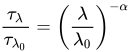
where is the optical thickness at wavelength , and is the optical thickness at the reference wavelength .[5][4] The parameter is the Angstrom exponent of the aerosol.


Significance
The Angstrom exponent is inversely related to the average size of the particles in the aerosol: the smaller the particles, the larger the exponent. For example, cloud droplets are usually large, and thus clouds have very small Angstrom exponent (nearly zero), and the optical depth does not change with wavelength. That is why clouds appear to be white or grey.
This relation can be used to estimate the particle size of an aerosol by measuring its optical depth at different wavelengths.
Determining the exponent
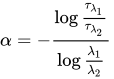
In principle, if the optical thickness at one wavelength and the Angstrom exponent are known, the optical thickness can be computed at a different wavelength. In practice, measurements are made of the optical thickness of an aerosol layer at two different wavelengths, and the Angstrom exponent is estimated from these measurements using this formula. The aerosol optical thickness can then be derived at all other wavelengths, within the range of validity of this formula.
For measurements of optical thickness and taken at two different wavelengths and respectively, the Angstrom exponent is given by


The Angstrom exponent is now routinely estimated by analyzing radiation measurements acquired on Earth Observation platforms, such as AErosol RObotic NETwork (AERONET).
See also
References
- ^ Gregory L. Schuster, Oleg Dubovik and Brent N. Holben (2006): "Angstrom exponent and bimodal aerosol size distributions". Journal of Geophysical Research: Atmospheres, volume 111, issue D7, article D07207, pages 1-14. doi:10.1029/2005JD006328
- ^ Itaru Sano (2004): "Optical thickness and Angstrom exponent of aerosols over the land and ocean from space-borne polarimetric data". Advances in Space Research, volume 34, issue 4, pages 833-837. doi:10.1016/j.asr.2003.06.039
- ^ D. A. Lack1 and J. M. Langridge (2013): "On the attribution of black and brown carbon light absorption using the Ångström exponent". Atmospheric Chemistry and Physics, volume 13, issue 20, pages 10535-10543. doi:10.5194/acp-13-10535-2013
- ^ a b Ji Li, Chao Liu, Yan Yin, and K. Raghavendra Kumar (2016): "Numerical investigation on the Ångström exponent of black carbon aerosol". Journal of Geophysical Research: Atmospheres, volume 121, issue 7, pages 3506-3518. doi:10.1002/2015JD024718
- ^ Anders Ångström (1929): "On the Atmospheric Transmission of Sun Radiation and on Dust in the Air". Geografiska Annaler, volume 11, issue 2, pages 156–166. doi:10.1080/20014422.1929.11880498
- IPCC Third Assessment Report, has extensive coverage of aerosol-climate interactions.
- Kuo-nan Liou (2002) An Introduction to Atmospheric Radiation, International Geophysics Series, No. 84, Academic Press, 583 p, ISBN 0-12-451451-0.
External links
Content Disclaimer
Informasi ini disarikan dari Wikipedia dan disajikan kembali untuk tujuan edukasi. Konten tersedia di bawah lisensi CC BY-SA 3.0. Kami tidak bertanggung jawab atas ketidakakuratan data yang bersumber dari kontribusi publik tersebut.
- The information displayed on this website is sourced in part or in whole from Wikipedia and has been adapted for the purpose of restating it. We strive to provide accurate and relevant information, however:
- There is no guarantee of absolute accuracy. Wikipedia is an open, collaborative project that can be edited by anyone, so information is subject to change.
- It is not intended to constitute professional advice. The content displayed is for informational and educational purposes only. For important decisions (e.g., medical, legal, or financial), please consult a professional.
- Content copyright. Wikipedia is licensed under the Creative Commons Attribution-ShareAlike License (CC BY-SA). This means that content may be reused with appropriate attribution and shared under a similar license.
- Responsible use. Any risk arising from the use of information from this website is entirely the responsibility of the user.